Sahan Journal wins February Sidney for Coverage of Operation Metro Surge
NEW YORK — Sahan Journal, a non-profit newsroom in Minnesota, wins the February Sidney Award for its coverage of Trump’s Operation Metro Surge (OMS). Billed as the largest immigration operation in history by federal authorities, and as an invasion by many Minnesotans, the government claims to have arrested some 4000 residents of Minnesota since the operation began in December.
Sahan has covered the killings of Renée Good and Alex Pretti by federal agents and the federal stonewalling of state-level investigations into their deaths. Sahan has also tackled ICE’s use of surveillance technology, the historic general strike, the arrests of activists who protested at Cities Church (which is pastored by a high-ranking ICE official), and Operation PARRIS (which targets refugees).
“Sahan Journal’s staff and leadership comes from the immigrant communities they cover which enables Sahan to report stories that no one else is telling. They are breaking news on a story that affects us all,” said Sidney judge Lindsay Beyerstein.
Aaron Nesheim, Dynmanh Chhoun, Katelyn Vue, Andrew Hazzard, Katrina Pross. Cynthia Tu, Becky Z. Dernbach, Mohamed Ibrahim, Shubhanjana Das, Alberto Villafan, Joey Peters and Samantha Hoang Long are covering Operation Metro Surge for Sahan Journal.
Additional contributors: Atra Mohamed, Binta Kanteh, Mohamud Farah, Nicolas Scibelli, Anshu Patel, Chris Juhn, Mark Porubcansky, Pam Miller. And Sahan editors: Chao Xiong and Trisha Collopy
Backstory
Q. What are the most important stories that Sahan Journal has broken since Operation Metro Surge started?
A: I wrote a story about a Latino man who was crashed into by ICE. He was a U.S. citizen who just happens to be Latino. That story went pretty big in the national news. His name was Christian Molina, and he was just rammed into and then demanded to show his papers. It was really instructive of the type of aggressive action ICE was carrying out here. We broke a big story about a Border Patrol agent who got a DUI and was found in basically a pool of his own vomit. That was a very big story. We’ve written a lot of stories about people who are being demanded to show their papers.
Q. What makes your approach to covering Operation Metro Surge unique?
A: We are doing our best to cover what it’s like for immigrant families here in the Twin Cities right now. We are trying to seek out stories that are not necessarily the ones that are going super viral on national news. We’re really trying to uncover stories here on the ground that are easy to overlook and trying to figure out the impact on everyday families, whether that’s families who are making difficult decisions about whether to go out to get groceries, whether to go out to bring their kids to the bus, stuff like that.
Q: Do you get a lot of tips from the local community?
A: A lot of people have been reaching out to tell us, like, “my husband was taken by ICE,” or my father was taken by ICE, my cousin, my coworker. We’ve done a good job of building an automated tip system for people to submit to us. We’ve also been doing a lot of call to actions on our stories, asking people like, “have you been affected by ICE?” “Are you seeing this in your neighborhood?” “Is your family being impacted by this?” And so people have been responding to those. People give out tips in different ways. Sometimes scrolling through the Instagram comments on a post about a story that you wrote can be a fruitful way to find someone else saying, hey, this also happened to me or something similar happened to my family and then trying to reach out to that person.
Q: What happens during an ICE arrest, if you’re the target? What do you experience? You’re walking down the street, and then what happens?
A: Typically people are approached while in transit. Usually they’re on their way to work. That’s the most common way that we’ve seen people be arrested by ICE - whether they’re driving or at a bus stop or walking down a sidewalk. And there are really two ways in which this happens. One way is that your car will suddenly be stopped and you will be rapidly approached by multiple agents. They will try to get you to roll down the window. And if people do not roll down the window and ICE believes that they have someone that they’re searching for, they will smash the window out of that car and take them. The other way is just approaching people on the street. They will approach people at bus stops and ask them about their immigration status. And if they feel that that person does not have a good answer, they will take them away.
Q: Have you seen that happen?
A: Yes, I have seen people be pulled out of their cars. In one instance, on a prominent street in South Minneapolis, several ICE vehicles blocked in a sedan on the side of the road. Like initiating a traffic stop, like normal police. Of course, they’re not necessarily normal police. They approached this vehicle. This person did roll down their window and answered some questions. They asked the person to step out, and the person went with them into their vehicle. So in that sense, it was not a super dramatic instance, but the whole time people were making noise, people were blowing whistles, honking horns. So it does turn into a bit of an event, for lack of a better term, and people are paying attention.
Q. What happens to their cars?
A: These cars have been found abandoned on the side of the road throughout the Twin Cities over the past month and a half. Often these cars are pulled off to the side but they’re not always perfectly pulled off to the side. There will be community members who are observing these ICE actions who will push the car over to a parking spot. When the person is taken out of the car, oftentimes the keys are left in the car. Oftentimes the person’s wallet or phone is left in the car. All their belongings are just there. And they’re being taken by ICE. So people will kind of push the car into a legal parking spot and then call a tow service. We’ve done an article here at Sahan Journal about these tow services that are offering free or heavily discounted services to bring these cars back to families after someone is taken by ICE. These abandoned cars have turned into a very eerie symbol of this surge operation in the Twin Cities.
Q. It’s like those Christian novels in the 90s where they had people getting raptured. Only it’s one person and they’ve been taken by ICE.
A: Yeah, yeah. It’s a very dark version of Left Behind.
Q: What role did the Sahan Journal play in covering the killings of Renee Good and Alex Pretti?
A: We were out there after both shootings. We had a photographer, Aaron Nesheim, who was on the scene of the Renée Good shooting within five minutes of it happening. He lives fairly close by, and he heard about it right away and he got some very harrowing shots of the immediate aftermath of the Renee Good shooting. I was there probably 10 to 15 minutes after it happened while the scene was still very, very chaotic. There were hundreds and hundreds of federal agents descending on this area. People were coming out. They were very upset to see this happening in their community. It was a very, very tense situation. Ultimately, I think ICE and Border Patrol realized it was a very bad situation. And then they just left. So the scene was left to local authorities. And there was an FBI team there taking forensics. But we were out there interviewing as many witnesses as we could.
You know, both these shootings happened in broad daylight. Both these shootings happened in a very public area, and both of them happened on very prominent streets. These are not small side streets. They are quasi-major streets in South Minneapolis where a lot of people live and work and go out to eat and stuff like that. I interviewed two or three eyewitnesses to the shooting. I had a colleague, Katelyn Vue, who was also there and speaking with multiple witnesses to the shooting. So we tried our best to compile an account from witnesses that we talked to, both who saw the shooting and who saw the immediate aftermath of the shooting. And then we attempted to do our best to capture what was going on, the response to it by the authorities, the interactions that ICE was having with members of the public.
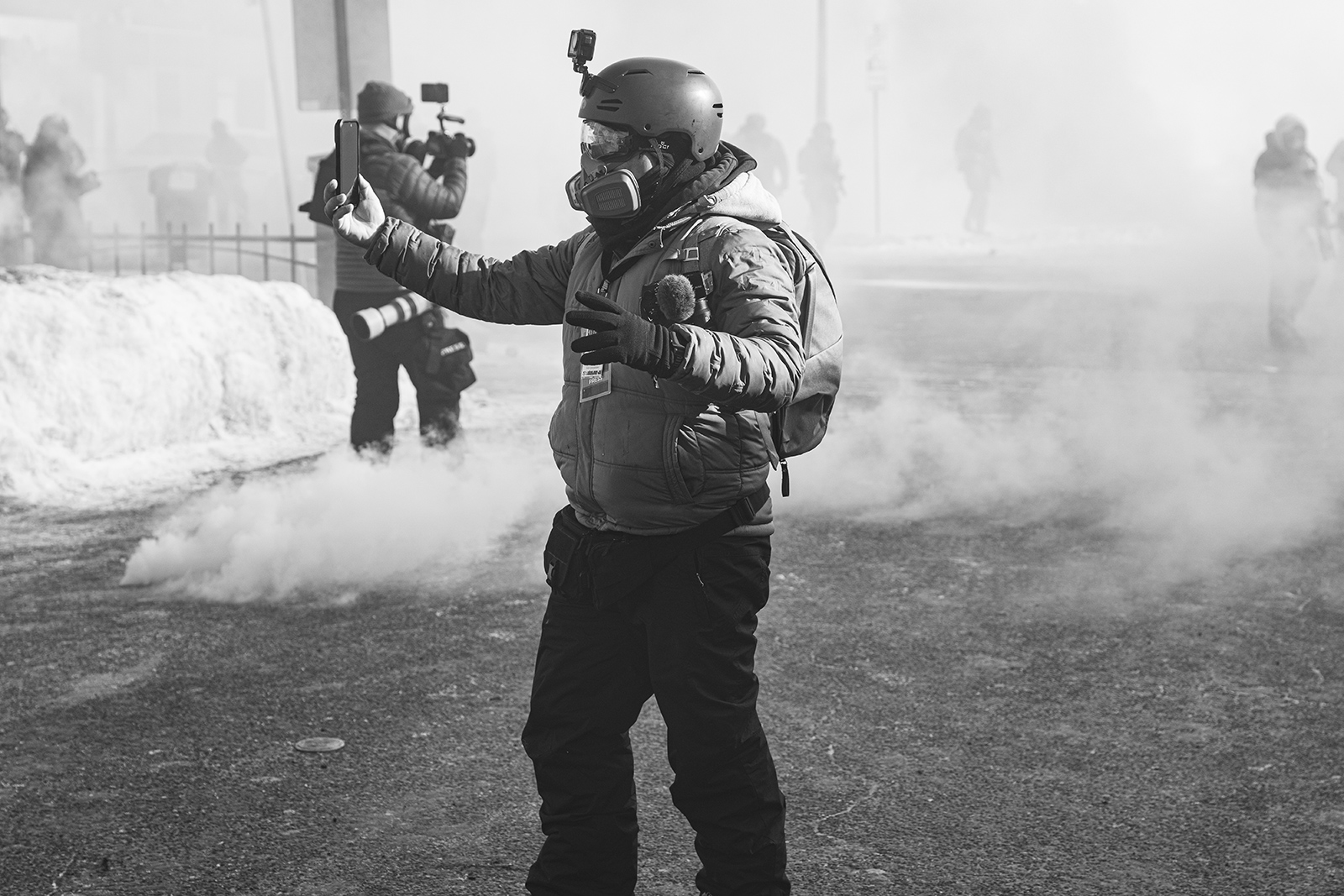
When Alex Pretti was shot and killed, that was on a Saturday. We had people out there pretty quickly after that who were documenting what was happening, who were on the ground trying to interview as many people as they could about what happened. There was a really tense scene after the Pretti shooting where ICE and Border Patrol were using tons and tons of tear gas and other crowd control munitions. And our video journalist Dymanh Chhoun got some really harrowing and amazing footage of this happening and the community response and the very heavy-handed put-down of that response by ICE and Border Patrol.
Q: How are ordinary Minnesotans pushing back?
A: There are multiple levels of participation in resistance to this. There are people like Renée Good or like Alex Pretti who are going out and observing and trying to track ICE movements throughout their neighborhoods to let people know if they’re around. There’s a huge network of people who are dropping off groceries for families who are scared to leave their homes right now, who are offering rides to immigrant neighbors who are too scared to drive because a lot of the ways that ICE and Border Patrol are arresting people is by running plates. And if the car is registered to a non - U.S. citizen, they will pull that person over and see if they’re someone who they can take. So offering rides, donating food, donating hygiene supplies, donating baby formula, diapers. There’s a huge network. A lot of it’s organized through churches or other faith congregations that are really trying their best to support people. It’s been a huge outpouring of community effort to try and help people who are attempting to stay under the radar right now.
Q: How does ICE decide who they’re going to grab?
A: I don’t know if they know how they decide who they’re going to grab. There are people that have final orders of removal or deportation orders, and they might go out looking for those people. Who ICE defines as a target is a really interesting question and it’s one that we’ve been trying to answer. ICE has said in their own words that they go out looking for specific individuals and that they’re looking at this through what they call intelligence but as they’re on their way to find that person or if they’re in a neighborhood or on a street looking for that person and they see other people who they have reasonable suspicion to doubt might not be in the country with full permission, they will arrest those people as well. That’s where we’ve seen repeated instances of racial profiling happening here in Minnesota, people being asked to explain why they’re here in the country, where they were born, if they’re a citizen, that sort of thing. That question, “where were you born?” is a question that we’re hearing that ICE is asking frequently.
Q: What are these so-called Kavanaugh stops and how are they affecting the situation on the ground?
A: Kavanaugh stops are racial profiling. The argument from DHS is that these are allowed. But this is not an official Supreme Court ruling. This is basically a footnote in Justice Kavanaugh’s opinion on a different ruling that says that in certain circumstances you can use things like race or language spoken to develop reasonable suspicion to inquire about someone’s immigration status. Now, this is being applied throughout the entire interior of the country. Basically, it’s a license to profile.
We have seen multiple instances in Minnesota of people who are being profiled, who are being aggressively stopped and asked to explain why they’re able to be in this country or asked if they’re citizens of this country. It’s happening a lot. We’ve spoken to Asian Americans, people of African descent, people of Latino descent, who have been stopped in this manner and racially profiled.
Q: Border Czar Tom Homan promised that there was going to be a “stand-down.” Do you see any evidence that things are easing up on the ground?
Not right now. On the ground in Minneapolis things continue apace. In the Twin Cities and surrounding suburbs, ICE is still very active. One thing for people to really think about and understand here is that when DHS did their big surge in Chicago, they sent an additional 400 to 500 agents to Chicago. Chicago has three times as many people as Minneapolis-St. Paul does. They had 3,000 agents here at the peak of their activity. They sent home 700. So that leaves 2,300 additional ICE agents more than the normal 80 who are on the ground here in the St. Paul Field Office. So the sheer volume, the sheer ratio of agents to potential targets is completely out of whack. That’s where things feel really, really disproportionate.
So, 700 of these guys were allegedly sent home. That’s welcome news to a lot of people here, but it still feels very much like there are many, many, many federal agents here and that they are picking people up with the same frequency and aggressive actions and aggressive actions towards citizen observers as well.
Q: What are the stories that you think will be most critical to keep covering in the weeks ahead?
I think the aftermath is going to be just as important as capturing this moment because it’s important to realize that there are going to be entire neighborhoods that are different now, entire suburbs of Minneapolis - St. Paul. When the smoke dies down, we’re going to have to do our best to document what’s left, and there really will be hundreds and hundreds of families that have been torn apart or had parents separated from their kids or small businesses that are going to close, and school districts whose enrollments are going to be changed. There are going to be a lot of stories to write in the aftermath of this, and I think it’s going to be as important as covering the surge.
Q: Is there one story, one encounter, one experience that really sums up what Operation Metro Surge has been like for you to cover as a reporter?
One thing that I keep coming back to in my head happened a couple of weeks ago. I was out and about looking around South Minneapolis in areas where I know ICE is active, and I heard that they may have stopped somebody on a street about ten blocks from where I was. So I headed over there. I arrived too late so I didn’t see what happened. But I came across this abandoned Jeep. And it was extremely cold that day. It was the coldest day we’ve had in a couple of years. It was probably 30 below zero. And this woman’s wallet and her keys were just sitting on the front seat of her car. A group of observers showed up. We were trying to get in contact with her family and get her car into a safe place so it could be towed by one of those services. And it just kind of struck me that this person is gone. I’m working to try and report out a story about these sudden disappearances. I was recently able to make contact with that woman’s family. She signed a self-deportation agreement and she won’t be returning to Minnesota, to the U .S. She’d been here for years. So coming across that and just seeing those aftermaths of like…you know, someone’s just gone now. That’s really kind of the lasting image to me of this operation.
There have been so many things - these big events where there’s dozens and dozens of masked agents and they’re throwing tear gas or they’re shooting pepper spray balls out of a paintball gun at people. Those have been very tense and dramatic. And obviously two people have been shot down in the street. Those things will stay in all of our memories for a long time. But for me, just the image of that abandoned car with its window rolled down on the coldest day of the year, that’s going to stick with me for a long time.